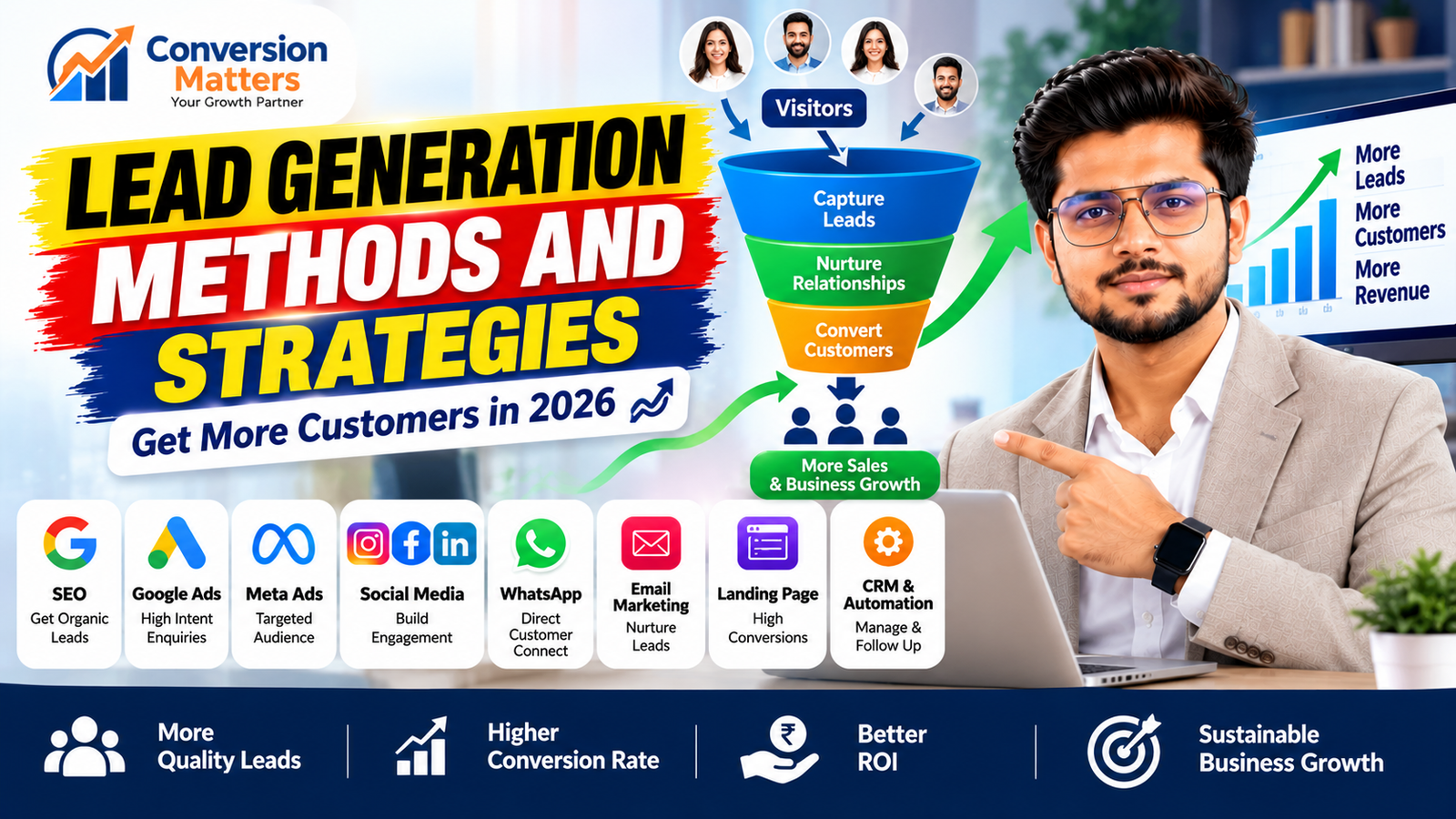
Every business needs a consistent flow of potential customers to grow. However, getting website visitors or social media followers does not automatically mean you will generate sales. You need a structured process to attract the right audience, capture their information, build trust, and convert interested prospects into paying customers.
This is where lead generation methods and strategies become important. Whether you run a digital marketing agency, coaching institute, eCommerce store, real estate business, or local service company, the right approach can help you find potential customers and improve your sales pipeline.
In this guide, we will explore proven lead generation techniques, digital marketing channels, automation tools, and practical steps to create a sustainable lead generation system.
What Is Lead Generation?
Lead generation is the process of attracting people who may be interested in your products or services and encouraging them to take an action, such as submitting a form, requesting a quotation, booking a consultation, or contacting your business on WhatsApp.
For example, a digital marketing agency may run Google Ads targeting business owners searching for SEO services. When an interested visitor fills out an enquiry form, the agency receives a lead that can be qualified and followed up.
Effective lead generation methods and strategies focus on attracting relevant prospects rather than collecting as many contacts as possible.
Why Are Lead Generation Methods and Strategies Important?
A structured lead generation process helps businesses identify potential buyers and build a predictable approach to customer acquisition.
Key benefits include:
- More qualified enquiries: Attract people whose needs match your services.
- Better marketing efficiency: Focus budgets on channels that produce meaningful results.
- Improved conversion rates: Guide prospects through a clear customer journey.
- Consistent follow-ups: Stay connected with interested prospects.
- Measurable performance: Track cost per lead, lead quality, and customer acquisition cost.
- Business growth: Build a repeatable process for attracting new customers.
Remember, generating leads is only the first step. Your sales process, service quality, pricing, and follow-up also influence the final results.
12 Best Lead Generation Methods and Strategies for Businesses
1. Search Engine Optimization (SEO)
SEO helps your website appear in relevant organic search results when potential customers look for your products or services.
For example, a local business may create optimized pages targeting keywords such as “digital marketing agency in Howrah” or “website designing services in Kolkata.”
To improve organic lead generation:
- Research keywords that match customer intent.
- Create helpful service pages and blog posts.
- Optimize page titles, headings, and meta descriptions.
- Improve website speed and mobile usability.
- Add clear enquiry forms and calls to action.
- Build relevant internal links and trustworthy backlinks.
- Optimize your Google Business Profile for local visibility.
SEO can support long-term lead generation, but results depend on competition, website quality, content, and search engine changes.
2. Google Ads
Google Ads allows businesses to reach people searching for specific products or services. Search campaigns can be particularly useful when users already demonstrate purchase intent.
For example, a pest control company can target relevant searches from people looking for pest control services in its service area.
To improve campaign performance:
- Select keywords that reflect commercial intent.
- Separate campaigns by service and location.
- Write relevant ad copy.
- Create dedicated landing pages.
- Track form submissions, phone calls, and qualified enquiries.
- Use negative keywords to reduce irrelevant traffic.
- Review conversion data before increasing budgets.
Among paid lead generation methods and strategies, Google Ads can be useful when you want to reach people actively searching for a solution.
3. Meta Ads: Facebook and Instagram
Facebook and Instagram advertising can help businesses reach audiences based on location, interests, demographics, and available platform targeting options.
These platforms can be effective for coaching institutes, beauty services, real estate, online courses, and other businesses with visually appealing offers.
For better results:
- Use a clear, benefit-driven headline.
- Highlight a specific customer problem.
- Show relevant product or service visuals.
- Offer a consultation, demo, or useful resource.
- Test different creatives and messages.
- Connect lead forms to a reliable follow-up process.
Avoid judging campaigns only by cheap leads. A campaign that generates fewer qualified prospects may be more valuable than one producing many irrelevant enquiries.
4. Landing Pages and Lead Capture Forms
A landing page is designed to encourage visitors to take a specific action.
Instead of sending every advertising visitor to your homepage, create a dedicated page explaining the offer and making the next step clear.
A high-converting landing page may include:
- A clear headline and value proposition.
- The main customer benefits.
- A description of the service or offer.
- Genuine testimonials or case studies.
- A short enquiry form.
- Contact details and a visible call to action.
- Relevant privacy information.
Keep forms simple and request only the information needed to qualify and respond to the enquiry.
5. Content Marketing
Content marketing attracts potential customers by answering their questions and helping them make informed decisions.
Examples include blog posts, guides, videos, checklists, case studies, and comparison articles.
A digital marketing agency could publish content about Google Ads costs, local SEO, website conversion optimization, or lead generation for small businesses.
You can also offer a useful resource in exchange for contact information, provided visitors understand what they are signing up for.
6. WhatsApp Marketing and Follow-Ups
WhatsApp can help businesses communicate with interested prospects, answer questions, and coordinate consultations.
For example, a coaching institute can provide course information and help prospective students schedule counselling sessions.
Practical approaches include:
- Adding a WhatsApp contact option to relevant website pages.
- Using click-to-WhatsApp advertising.
- Responding promptly to enquiries.
- Organizing leads using a CRM.
- Creating appropriate follow-up workflows.
- Obtaining required permission before sending marketing messages.
Use automation to simplify repetitive tasks while keeping human support available for complex questions.
7. Email Marketing
Email marketing helps businesses nurture prospects who are not ready to buy immediately.
A useful email sequence might include a welcome message, an educational resource, a relevant case study, and an invitation to book a consultation.
Keep your messages relevant and follow applicable consent, privacy, and unsubscribe requirements.
Email marketing is particularly useful for businesses with longer sales cycles, such as B2B services, software, consulting, and professional training.
8. Social Media Marketing
Organic social media helps businesses demonstrate expertise, build credibility, and engage with potential customers.
Publish content that answers common questions, explains your process, demonstrates your work, and addresses customer concerns.
For example, an agency could share SEO audits, advertising lessons, website improvements, and genuine client results with appropriate permission.
Include a relevant call to action so interested users know how to enquire.
9. Referral and Partnership Marketing
Existing customers, professional contacts, and complementary businesses can introduce you to new prospects.
A web development company might partner with branding consultants, while an accountant could build referral relationships with business consultants.
To develop this channel:
- Deliver a positive customer experience.
- Ask satisfied customers for referrals when appropriate.
- Build relationships with complementary service providers.
- Make it easy to explain what your business offers.
- Track referrals and the quality of resulting enquiries.
Referrals can produce valuable opportunities because prospects may already have some trust in the person recommending you.
10. Lead Magnets and Free Consultations
A lead magnet is a useful resource or experience offered to encourage a prospect to share their contact details.
Examples include:
- Free website audits.
- SEO checklists.
- Downloadable business guides.
- Product demonstrations.
- Discovery calls.
- Sample lessons or consultations.
The offer should solve a specific problem and attract people who are likely to benefit from your paid service.
A free offer is most effective when it connects naturally to the next step in your sales process.
11. Local SEO and Google Business Profile
Local businesses can use Google Business Profile and location-focused website content to improve their visibility in relevant local searches.
Keep your business name, address, phone number, hours, service areas, and categories accurate. Add genuine photos, respond to reviews, and make it easy for customers to contact you.
Create useful service pages for the locations you genuinely serve. Avoid publishing repetitive pages for locations where you do not provide services.
Local SEO can be particularly valuable for salons, clinics, restaurants, home services, coaching centres, and professional service providers.
12. CRM and Marketing Automation
A customer relationship management (CRM) system helps businesses organize leads, record interactions, and manage follow-ups.
A simple workflow might look like this:
- A prospect submits a website form.
- Their details enter the CRM.
- The relevant team member receives a notification.
- The prospect receives an appropriate acknowledgement.
- A sales representative follows up.
- The lead is marked as qualified, converted, or not interested.
These lead generation methods and strategies become more effective when businesses can identify where leads originate and which prospects ultimately become customers.
How to Build a Lead Generation Strategy Step by Step
Use this framework to create a practical lead generation plan.
Step 1: Define your ideal customer. Identify your audience, location, problems, budget, and buying requirements.
Step 2: Create a relevant offer. Explain how your product or service solves a specific problem.
Step 3: Select suitable channels. Choose SEO, Google Ads, Meta Ads, partnerships, content marketing, or other channels according to your audience and budget.
Step 4: Build a conversion path. Connect your campaign to a relevant landing page, enquiry form, booking system, or messaging channel.
Step 5: Establish follow-ups. Decide who responds to new leads, how quickly they respond, and how further communication will be managed.
Step 6: Track results. Measure qualified leads, sales, acquisition costs, and return on advertising spend where relevant.
Step 7: Optimize continuously. Improve campaigns using actual conversion data rather than assumptions alone.
Important Lead Generation Metrics to Track
| Metric | What It Tells You |
|---|---|
| Leads generated | Total enquiries received |
| Cost per lead (CPL) | Marketing spend divided by leads generated |
| Lead qualification rate | Percentage of leads meeting your criteria |
| Lead-to-customer conversion rate | Percentage of leads that become customers |
| Customer acquisition cost (CAC) | Cost of acquiring a customer |
| Return on ad spend (ROAS) | Revenue attributed to advertising relative to ad spend |
For example, if you spend ₹10,000 and generate 100 leads, your cost per lead is ₹100. However, the campaign’s real value depends on how many leads qualify and become paying customers.
Common Lead Generation Mistakes to Avoid
- Targeting an audience that is too broad.
- Choosing keywords without considering search intent.
- Sending advertising traffic to an irrelevant page.
- Using unclear or misleading offers.
- Taking too long to respond to enquiries.
- Ignoring lead quality and sales conversion rates.
- Failing to track marketing costs and revenue.
- Sending unsolicited marketing messages.
- Scaling campaigns before validating their performance.
A reliable lead generation system combines audience research, a relevant offer, a clear conversion path, consistent follow-ups, and regular measurement.
Frequently Asked Questions
1. What are the best lead generation methods and strategies?
SEO, Google Ads, Meta Ads, content marketing, landing pages, referrals, email marketing, WhatsApp communication, and CRM automation are useful options. The best combination depends on your audience, industry, and budget.
2. Which lead generation strategy is best for small businesses?
Local SEO, Google Business Profile optimization, referral marketing, relevant social media content, and simple landing pages can be practical starting points. Paid advertising may also help when the offer and conversion tracking are ready.
3. How can I generate leads without paid advertising?
You can focus on SEO, helpful content, organic social media, professional networking, referrals, partnerships, and relevant online communities. These methods require time and consistent effort.
4. Are paid ads better than SEO for lead generation?
Paid ads can provide quicker campaign feedback, while SEO can build organic visibility over time. Neither guarantees results. Your choice should reflect your timeline, competition, budget, and customer acquisition goals.
5. How can I improve lead quality?
Refine audience targeting, use relevant offers, ask suitable qualifying questions, create focused landing pages, and review which lead sources generate paying customers.
Conclusion
The right lead generation methods and strategies help businesses attract relevant prospects, improve enquiry management, and create a more consistent customer acquisition process.
Start by understanding your ideal audience, selecting the right marketing channels, creating a compelling offer, and building a simple conversion funnel. Then measure qualified leads and actual sales to determine what deserves further investment.
Need help generating more qualified leads for your business?
Conversion Matters helps businesses explore digital marketing, SEO, paid advertising, and lead generation solutions tailored to their goals. Contact our team at 8910476346 to discuss your business requirements.